
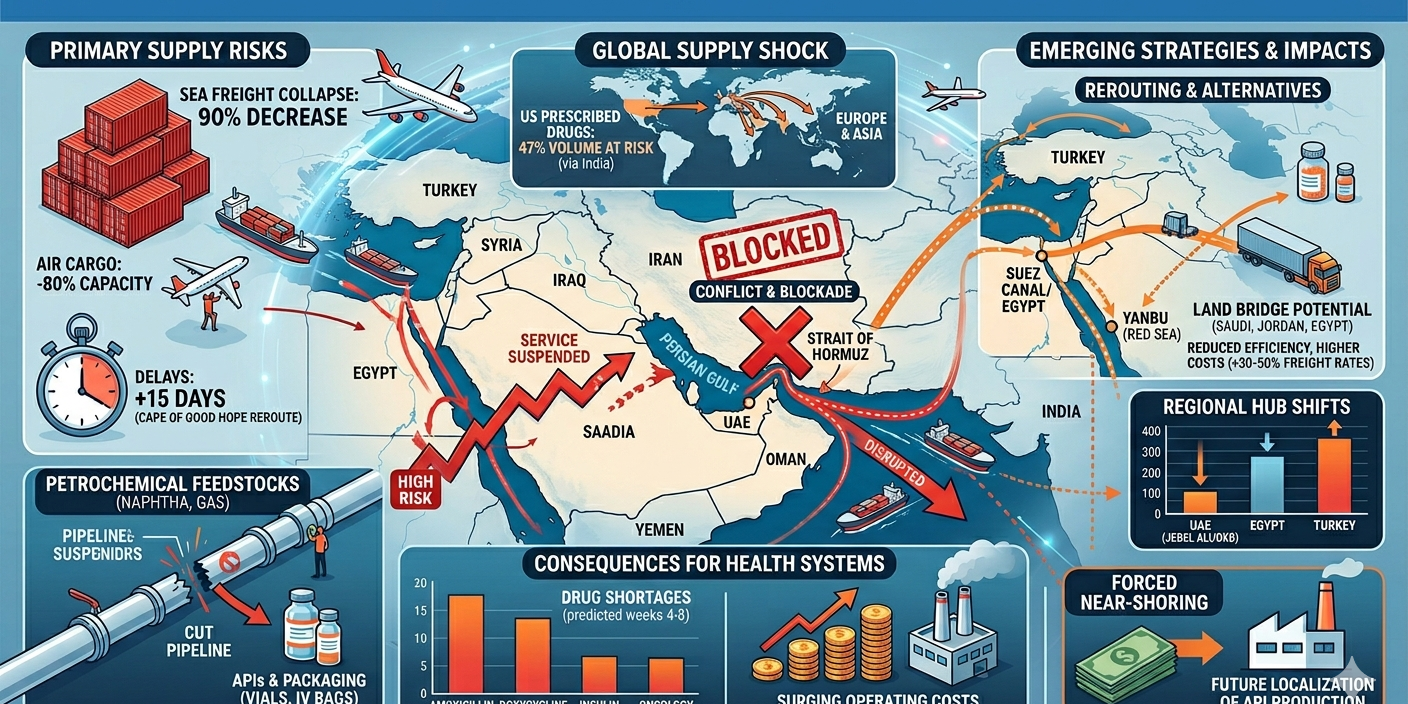
While headlines fixate on oil prices and military escalation, a quieter but potentially more dangerous disruption is unfolding beneath the surface.
The escalating U.S.–Iran conflict—and the instability around the Strait of Hormuz—is not just an energy story. It is the early stage of a pharmaceutical supply chain crisis that could reshape access to medicines across the Middle East, Africa, and beyond.
Because when a chokepoint closes, medicines don’t just get delayed, they disappear.
Why the Strait of Hormuz Matters for Pharma
Roughly 20% of global oil flows through the Strait of Hormuz, making it one of the most critical arteries of global trade.
But pharma executives should be paying attention for a different reason:
- It connects Asia (API manufacturing hubs) with Middle East & Europe markets
- It supports air cargo hubs like Dubai and Doha—critical for temperature-sensitive drugs
- It underpins energy supply, which directly affects pharmaceutical production costs
When this corridor is disrupted, pharma doesn’t stop immediately—but it begins to strain.
From Oil Shock to Medicine Shock
At first glance, pharmaceuticals seem insulated. The Middle East produces only a small fraction of global medicines and APIs.
But this is misleading.
The real risk is not production, it’s connectivity.
Here’s how the disruption spreads:
1. Logistics Breakdown
- Shipping routes are rerouted or delayed
- Air freight corridors are restricted
- Transit times increase by 10–14 days when rerouting via longer routes
For pharma, time is not a luxury, it’s a constraint.
2. Cold Chain Vulnerability
Biologics, vaccines, and insulin depend on strict temperature control.
With:
- Flight cancellations
- Port congestion
- Extended transit times
the risk shifts from delay → product spoilage.
3. API Supply Disruptions
The pharma industry is heavily dependent on:
- China for intermediates
- India for generics manufacturing
Disruptions in Hormuz are now affecting Chinese shipping flows, raising concerns about:
- Active Pharmaceutical Ingredients (APIs)
- Key Starting Materials (KSMs)
This is where the real bottleneck begins.
The Lag Effect: Why the Worst Is Yet to Come
Pharma supply chains are not reactive, they are buffered.
That means:
- Initial weeks show minimal disruption
- Real impact appears after 4–8 weeks
We are now entering that phase.
Industry signals already show:
- Rising logistics costs
- Delayed shipments
- Increasing uncertainty in supply continuity
And if the conflict persists, drug shortages become a probability—not a risk.
Rising Costs, Shrinking Access
Even without full disruption, the economy is shifting fast:
- War-risk insurance premiums rising sharply
- Freight costs are increasing significantly
- Energy prices inflating manufacturing costs
If sustained, this leads to:
- Higher drug prices
- Reduced availability in low- and middle-income markets
- Pressure on public healthcare systems
This is not just a supply chain issue—it’s an access crisis.
What Makes This Crisis Different
This is not a typical disruption.
It is a dual chokepoint scenario:
- Strait of Hormuz instability
- Red Sea / Suez disruptions (parallel pressure)
Together, they create what analysts call a “systemic trade bottleneck” with potential global ripple effects.
For pharma, this means:
- No easy rerouting
- No quick fixes
- No single-point solution
Strategic Implications for Pharma Leaders
This crisis is exposing structural weaknesses in the pharma industry:
🔹 Overdependence on limited supply hubs
🔹 Lean inventory models with low buffers
🔹 Lack of regional manufacturing resilience
Forward-looking companies are already considering:
- Multi-region API sourcing
- Nearshoring manufacturing
- Strategic stockpiling of critical drugs
- AI-driven supply chain monitoring
Conclusion: A Silent Crisis Turning Visible
The Strait of Hormuz may reopen. Diplomatic tensions may ease.
But the lesson is already clear the pharmaceutical supply chain is not as resilient as it appears.
What begins as a geopolitical conflict can quickly evolve into a global health risk—not through explosions, but through empty shelves, delayed treatments, and inaccessible medicines. And by the time the world notices, it may already be too late.