
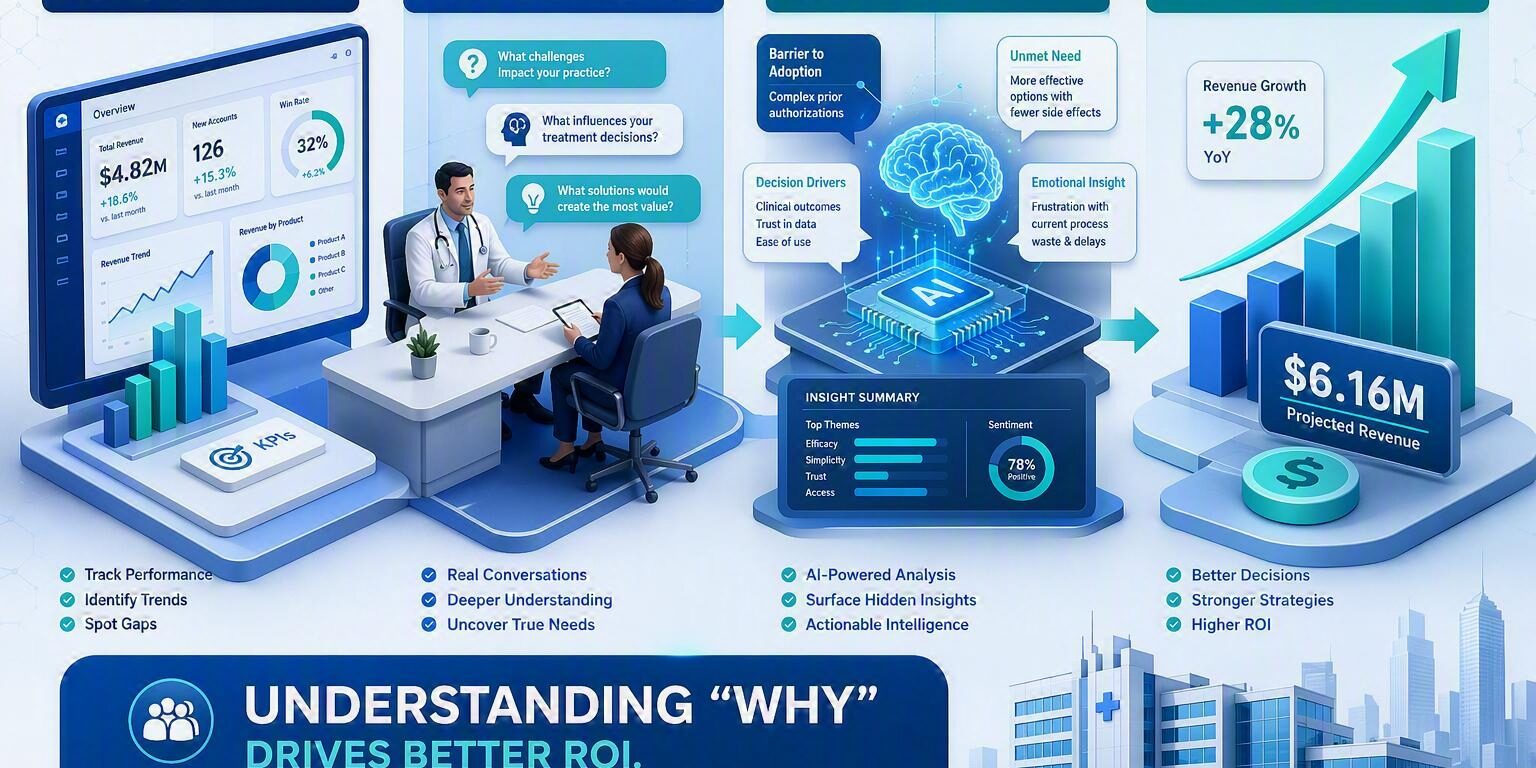
In pharmaceutical and healthcare marketing, return on investment (ROI) is often measured using the most visible metrics: sales growth, prescription volume, market share, and promotional spending. While these indicators are essential, they only tell us what happened. They rarely explain why it happened.
A brand may experience declining sales despite maintaining field force activity. Another may outperform competitors despite having a smaller promotional budget. Understanding the drivers behind these outcomes requires looking beyond commercial dashboards and listening directly to healthcare providers (HCPs).
This is where Sales Performance Indicators (SPIs) derived from field interviews become invaluable.
Connecting SPIs to ROI
The relationship between SPIs and commercial performance is supported by a growing body of Sales Force Effectiveness research. Studies evaluating healthcare provider engagement have found that promotional messages with strong physician recall typically achieve recall rates of 40–50%, while message effectiveness scores often reach 60–65% when communication is clear, clinically relevant, and delivered consistently. In contrast, messages with poor recall frequently fall below 30%, reducing their ability to influence prescribing decisions. Research has also shown that field-force interactions perceived as valuable by physicians are significantly more likely to generate engagement and prescribing consideration than routine promotional visits. From a ROI perspective, organizations that regularly conduct structured healthcare provider interviews gain an important advantage. By identifying weaknesses in message recall, scientific credibility, representative performance, and brand positioning early, companies can intervene before commercial impact becomes visible in sales reports. In practical terms, brands that act on field-interview insights often experience measurable improvements in promotional efficiency, while organizations relying solely on sales reports may not detect performance issues until market share or prescription volume has already declined.
For example, two brands may generate the same number of sales calls. However, if Brand A conducts regular physician interviews and improves message recall from 28% to 45%, while Brand B does not measure physician feedback and remains at 28% recall, Brand A is likely to achieve greater prescribing influence and higher return on promotional investment because corrective actions are taken before sales erosion occur.
The real value of field interviews emerges when SPIs are connected to commercial outcomes.
Consider a situation where a brand experiences flat sales growth.
Sales data alone might suggest the field force is underperforming.
However, physician interviews may reveal:
• Excellent representative ratings
• Strong message recall
• High scientific credibility
• Improved brand preference
In this case, the issue may not be promotional effectiveness. The underlying cause could be:
• Market access restrictions
• Pricing challenges
• Supply disruptions
• Increased competitive activity
Conversely, declining SPIs often act as early indicators of future sales erosion, allowing organizations to intervene before revenue is affected.
Discovering Field Sales Performance Gaps Early
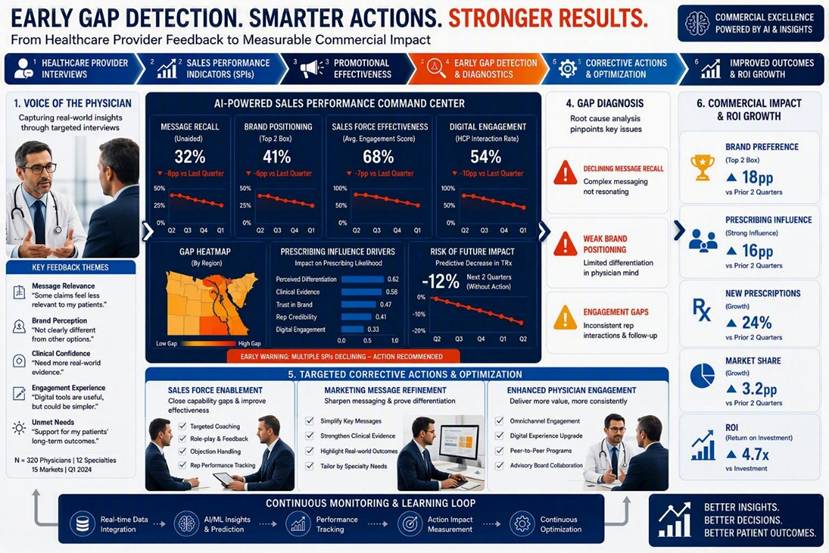
One important advantage of using Sales Performance Indicators from healthcare provider interviews is the ability to detect gaps in field sales performance before they become visible in sales results. Traditional sales reports often identify performance problems only after market share, prescription volume, or revenue has already been affected. By contrast, field-based SPI research provides earlier signals that help organizations understand where performance is weakening and why.
These gaps may appear in several forms. Physicians may not recall the key promotional messages, even when call frequency is high. They may perceive the representative as knowledgeable but find the brand positioning unclear. In other cases, the message may be memorable but not credible enough to influence prescribing behavior. Field interviews can also reveal differences across regions, specialties, physician segments, or individual customer groups, helping management identify whether the issue is related to messaging, representative execution, targeting, competitive pressure, or external market barriers.
The value of identifying these gaps early is that organizations can act before the problem translates into lost sales momentum. If message recall is low, marketing teams can simplify or reprioritize the communication strategy. If representative knowledge scores are weak, sales leaders can strengthen training and coaching. If brand differentiation is unclear, the team can refine positioning and reinforce clinical evidence. If certain physician segments show lower engagement or weaker prescribing influence, targeting and account planning can be adjusted accordingly.
This turns SPI research from a diagnostic tool into an early intervention system. Instead of waiting for quarterly sales results to confirm a problem, companies can use physician feedback to address performance gaps while there is still time to correct courses. Early action improves the efficiency of sales and marketing investments, reduces wasted promotional effort, and increases the likelihood that commercial activities will generate measurable ROI.
Improving Sales-Marketing Alignment Through SPI Insights
One of the most valuable outcomes of linking SPIs to ROI is the ability to improve alignment between sales and marketing teams. In many organizations, sales performance is often evaluated solely through revenue outcomes, while marketing effectiveness is measured through campaign execution and message delivery. This can create disconnects when sales targets are not achieved, leading to uncertainty about whether the root cause lies in the promotional strategy, field execution, or external market dynamics.
Field interviews help bridge this gap by providing objective evidence of how marketing messages are translated into physician perceptions and prescribing behaviors. When healthcare providers report strong message recall, high scientific credibility, and positive brand sentiment, marketing teams gain confirmation that their content and positioning strategies are effective. Simultaneously, sales leaders can verify that representatives are delivering those messages consistently and successfully.
By combining SPI data with commercial performance indicators, organizations can distinguish between communication-related issues and broader market challenges. This creates a shared understanding of performance drivers, enabling both teams to focus on the areas that require intervention. Marketing can refine messaging based on physician feedback, while sales teams can adjust targeting, engagement frequency, or account strategies. The result is a more coordinated approach to brand growth, faster decision-making, and more efficient allocation of resources.
Ultimately, SPI-driven insights transform sales and marketing discussions from assumptions and opinions into data-driven conversations, creating stronger alignment around common objectives and improving the organization’s ability to maximize ROI.
The ROI Measurement Challenge
Many organizations calculate ROI by comparing sales outcomes against marketing and sales investments. While this approach provides a financial perspective, it often misses the operational and behavioral factors influencing performance.
The reality is that sales results are often the final outcome of a chain of events that began months earlier:
• Sales representative interactions
• Message delivery quality
• Scientific credibility
• Physician perception of the brand
• Competitive activity
• Access barriers
• Prescribing confidence
By the time changes appear in sales reports, opportunities to intervene may already be lost.
As highlighted in internal Sales Force Effectiveness (SFE) and ROI frameworks, leading indicators such as HCP feedback, message recall, Net Promoter Score (NPS), Brand Equity, physician engagement, and representative performance provide early warning signals that help explain future sales performance.
Looking Beyond Traditional KPIs
Traditional commercial KPIs typically include:
• Sales value
• Market share
• Prescription volume
• Call frequency
• Coverage metrics
These metrics are useful but incomplete.
Field interviews with healthcare providers unlock an entirely different layer of intelligence by measuring:
• Recall of key promotional messages
• Perceived representative expertise
• Scientific credibility
• Brand differentiation
• Competitive positioning
• Influence on prescribing decisions
• Barriers to adoption
These indicators provide context that sales data alone cannot deliver.
Why Healthcare Provider Interviews Matter
Healthcare professionals are the ultimate recipients of pharmaceutical communication. Their perceptions directly influence prescribing decisions, making them one of the most important sources of performance insight.
Through structured interviews, organizations can answer questions such as:
Is the Message Being Remembered?
A sales team may be highly active, but if physicians cannot recall the key clinical messages after a visit, the promotional investment is unlikely to generate maximum return.
Is the Representative Building Trust?
HCP perceptions of representative knowledge, credibility, and professionalism are strong predictors of future engagement and influence.
Is the Brand Differentiated?
Physicians may recognize a product but fail to understand how it differs from competing therapies.
Are Competitors Winning the Conversation?
Interviews often reveal emerging competitive threats before they become visible in market share reports.
These insights transform sales reporting from a retrospective exercise into a forward-looking management tool.
The Most Valuable Sales Performance Indicators (SPIs)
Based on Sales Force Effectiveness and Message Recall research frameworks, several SPIs consistently demonstrate strong explanatory power for commercial performance.
Message Recall
Measures the percentage of physicians who remember promotional messages after representative visits.
High recall suggestion:
• Effective communication
• Strong message clarity
• Better potential prescribing influence
Low recall often indicates:
• Overloaded messaging
• Poor message prioritization
• Inadequate training
Message Credibility
A memorable message is not necessarily a believable one.
Physicians evaluate:
• Scientific validity
• Clinical relevance
• Consistency with experience
Credibility frequently has a stronger impact on prescribing behavior than simple awareness.
Representative Knowledge and Scientific Competence
Healthcare providers consistently value representatives who can:
• Discuss clinical evidence confidently
• Answer medical questions accurately
• Demonstrate disease-area expertise
Research repeatedly shows that representative competence significantly impacts physician trust and engagement.
Brand Positioning
Field interviews reveal whether physicians understand:
• What the brand stands for
• Which patients it best serves
• How it differs from alternatives
When positioning is weak, commercial investments often fail to translate into prescribing momentum.
Prescribing Influence
One of the most powerful SPIs measures the extent to which HCPs believe promotional interactions influence their treatment decisions.
While prescribing behavior is affected by many factors, understanding perceived influence helps organizations identify the activities delivering genuine value.
From Measurement to Action
The purpose of SPI research is not simply to generate reports.
The objective is to improve decision-making.
When healthcare provider interviews reveal weaknesses, organizations can take targeted actions:
Improve Representative Training
Address knowledge gaps and strengthen scientific communication.
Optimize Messaging
Focus on messages physicians find most relevant, memorable, and persuasive.
Refine Targeting
Identify specialties, regions, or physician segments where performance differs significantly.
Strengthening Competitive Positioning
Address misconceptions and reinforce differentiating clinical evidence.
Reallocate Resources
Shift investment toward activities that demonstrate the highest impact on physician perception and engagement.
Conclusion
Measuring return on investment in pharmaceutical sales requires looking beyond financial outcomes and traditional performance metrics. While sales figures reveal what has happened, field interviews with healthcare providers explain why it happened by uncovering the perceptions, behaviors, and barriers that drive prescribing decisions. By integrating Sales Performance Indicators (SPIs) such as message recall, scientific credibility, representative effectiveness, and brand positioning into ROI analysis, organizations gain a more comprehensive understanding of commercial performance. This insight enables earlier interventions, more informed strategic decisions, and smarter allocation of resources ultimately maximizing the impact of sales and marketing investments while building stronger relationships with healthcare professionals.